I remember scrolling through anime recommendations back in 2016, completely overlooking Bungo Stray Dogs. The promotional art made it look like just another supernatural action series—flashy powers, quirky characters, and predictable shonen tropes. How wrong I was. Now, in 2026, looking back at a decade of anime, I realize that skipping this series initially was one of my biggest viewing mistakes. What begins as a seemingly lighthearted detective romp with literary references slowly, masterfully, peels back its layers to reveal one of the most psychologically complex and narratively gripping stories I've ever experienced.

The journey begins with Atsushi Nakajima, a homeless teenager haunted by a literal and metaphorical tiger from his past. His rescue and recruitment by the Armed Detective Agency (ADA) feels familiar at first—a found family of gifted individuals solving supernatural cases in Yokohama. The early episodes are deceptively simple, filled with banter, slapstick comedy, and episodic mysteries. I'll admit, I almost dropped it. The pacing felt leisurely, almost slow. But this foundation is everything. Those early, seemingly frivolous moments of Dazai's comedic suicide attempts, Kunikida's frantic schedule-keeping, and Atsushi's wide-eyed wonder aren't just filler. They are the careful laying of bricks for an emotional fortress that the narrative will later siege with devastating force. You need to know these people at their most relaxed to truly feel the weight when the world forces them to their breaking point.
What truly elevates Bungo Stray Dogs is its refusal to let its characters remain as archetypes. They evolve, and their evolution is painful, beautiful, and deeply human. Atsushi's growth isn't just about controlling his ability; it's a raw, ongoing battle with self-worth born from severe abuse. The carefree, bandage-wrapped Dazai Osamu, who initially seems like a comic relief genius, hides an ocean of darkness—a past as an executive in the Port Mafia and a philosophical weariness with life that makes his humor profoundly melancholic. Every member, from the fiercely principled Kunikida to the quiet, protective Akiko Yosano, carries deep scars and complex moral codes. The series has a brilliant way of making you reassess characters with each new season. An antagonist in one arc becomes a tragic figure in the next; an ally's past actions cast a long, troubling shadow. There are no purely good or evil characters, only people shaped by trauma, ideology, and the gray morality of a city divided between gifted agencies.
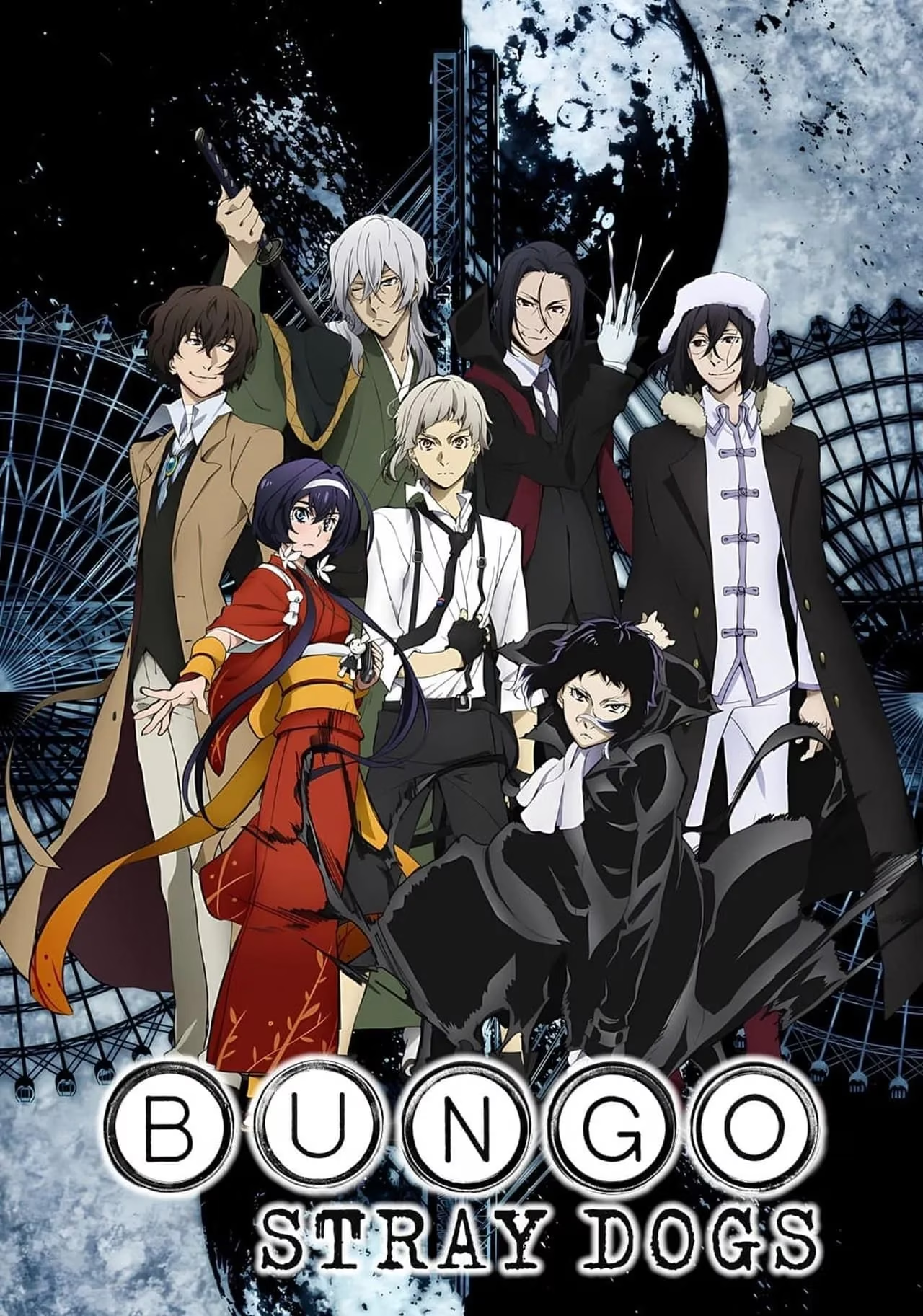
This is where the series sheds its initial skin completely. By the second season, any pretense of a simple monster-of-the-week show is gone, replaced by a gritty, cerebral war. The anime delves into themes most shonen would shy away from:
-
The Psychology of Violence: Abilities are often metaphors for trauma. Using one's power is frequently tied to reliving past pain.
-
Existential Dread & Suicidal Ideation: Dazai's quest for a "reason to live" and his fascination with death is treated with startling seriousness, not just as a quirk.
-
The Cycle of Abuse: Multiple character arcs, especially Atsushi's and Kyoka's, are direct explorations of surviving abuse and learning to define oneself outside of it.
-
Philosophical Conflict: The battles are as much about clashing ideologies (order vs. chaos, justice vs. survival, the meaning of humanity) as they are about flashy power clashes.
The narrative structure is a masterclass in tension. Each season raises the stakes exponentially, not just in power levels, but in emotional and moral cost. Alliances shatter, beloved characters are put in impossible situations, and the line between the "good" ADA and the "evil" Port Mafia blurs until it's nearly invisible. The mastermind antagonists, particularly Fyodor Dostoevsky, don't just want to win fights; they want to break wills, prove philosophical points, and watch the world burn from the comfort of a prison cell. The manipulation is layered, the strategies are cerebral, and the consequences are permanent.
Watching it now, in 2026, its brilliance is even more apparent. In an era where anime trends can feel cyclical, Bungo Stray Dogs remains uniquely itself. It's a series that demands patience and rewards it a hundredfold. It asks you to invest in its characters' quiet moments so their screams of anguish later hit with full force. It builds a world so rich in lore and conflict that every rewatch reveals new foreshadowing and subtle character details. For anyone who thinks they've seen all that supernatural action anime has to offer, I offer this: you haven't, not until you've walked the rain-soaked streets of Yokohama with the Armed Detective Agency. Don't make my initial mistake. Look beneath the surface, and you'll find a modern classic waiting to be discovered. It's more than an anime; it's a profound exploration of light, darkness, and the fragile humanity struggling in between.