I still remember the way the rain tasted that morning in Seattle, cold and metallic, as if the sky itself was mourning a city long past saving. Ellie’s horse shifted beneath me, hooves slapping wet asphalt, and Dina’s voice came soft through the mist, pointing toward a half-collapsed building I’d never seen before. That moment—unguarded, unhurried—felt like the game was leaning in to whisper a secret. That single stretch of land, a quiet pocket of openness in a story otherwise cinched tight by grief and necessity, taught me what The Last of Us could become when it let us wander. And now, in 2026, with whispers of Part 3 finally growing louder, I find myself hoping Naughty Dog remembers that breath.
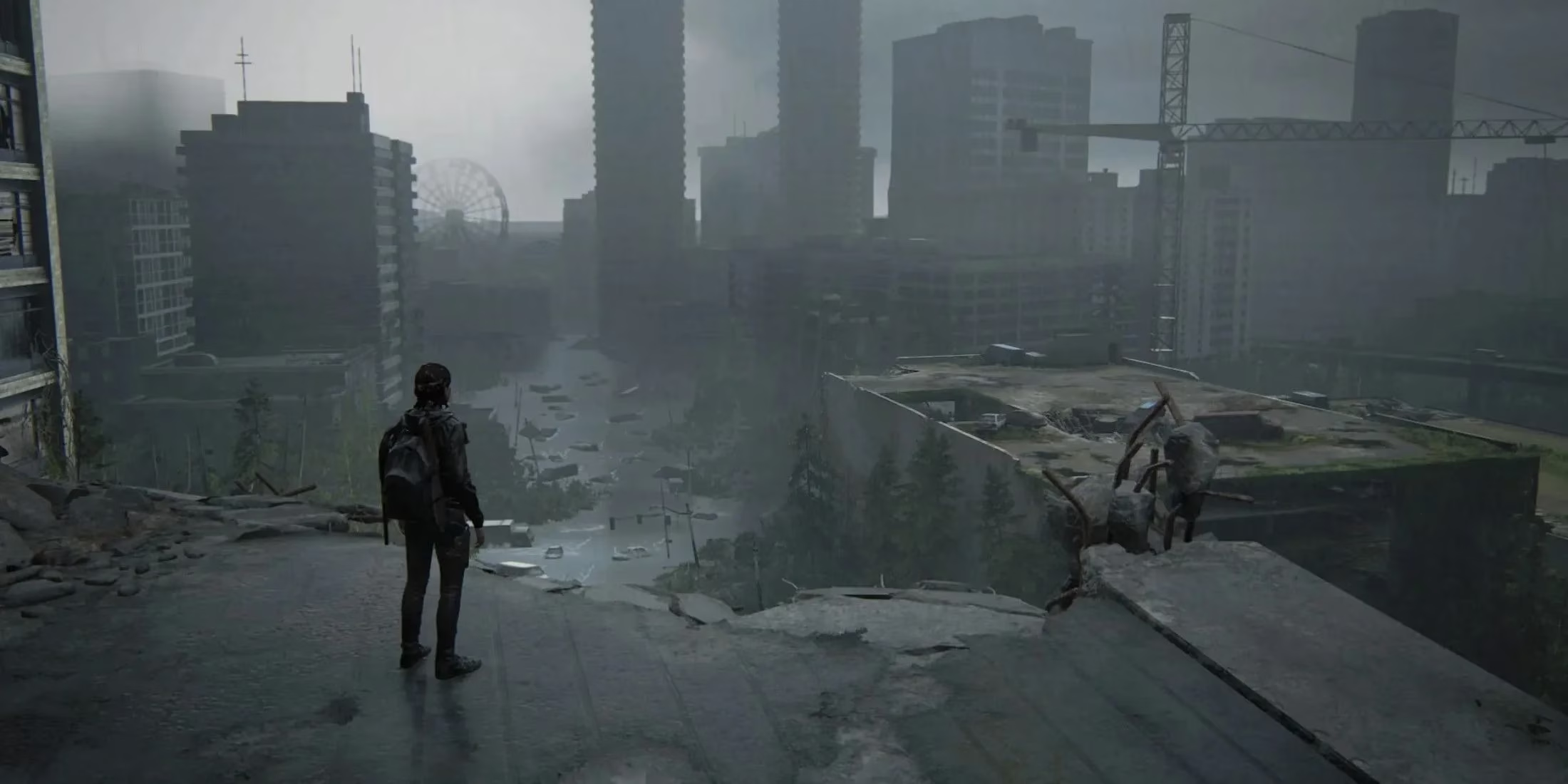
I’ve walked those streets so many times since. Not to chase a waypoint, but just to be there—to listen to the silence between shattered windows, to find a shotgun rusting in a forgotten safe, to hear Ellie murmur something about her old life that she’d never say when the world was screaming. That early Seattle section wasn’t a level, y’know? It was a living, grieving thing. The map in my hands wasn’t just a menu; it grew with me, each scribbled note a memory stitched into the parchment. Naughty Dog gave us a compass and said, “Go on, get lost.” And getting lost has never felt so much like being found.
Honestly, I was floored when I learned the team nearly made the entire game that way—a sprawling open world where every corner could hold a story. Part of me longs for that parallel universe, but another part, the one that still lies awake thinking about Abby’s final swing of the golf club, knows why they pulled back. An ocean of freedom would have drowned the narrative. This isn’t a franchise that thrives on distraction; it thrives on pressure, on the claustrophobia of a linear path narrowing until your knuckles turn white. Yet that one pocket of Seattle proved something remarkable: you can let a world exhale without losing the tension in its lungs. It’s a balancing act, and now, with Part 3 on the distant horizon, I believe the sequel can learn to walk that tightrope even more gracefully.
Here’s what I’m dreaming of, if I may. Picture not just one open sanctuary, but several—each a different season of the soul. A desolate Wyoming valley where the wind carves prayers through empty barns; a flooded coastal town where boats creak secrets to one another; a dense southern forest that hums with the rhythm of things that survived. Every sandbox could be a tonal shift, a space where the map becomes a character in itself, evolving as you poke at its wounds and uncover its kindnesses. The first game taught us how to survive; the second, how to grieve; the third, perhaps, could teach us how to heal—and healing needs room to wander.
I keep thinking about the way Bloodborne’s interconnected world used to fold back on itself, how a locked gate would suddenly sigh open hours later, whispering, “See? You were here all along.” Naughty Dog flirted with that idea, drawing inspiration from FromSoftware’s design, and I’d love to see them lean in harder. What if a sandbox area in Part 3 wasn’t just a wide field of optional encounters, but a knot you untie over time? A loop that threads shortcuts and soulful discoveries together until the whole place feels like a second heartbeat. You know what I mean—that feeling when a space stops being a level and becomes a home you’re losing, slowly, inevitably.
Maybe I’m too romantic. But The Last of Us has always been a romance, just the kind where love is a wound and time is the salt. If Part 3 wants to evolve beyond its predecessor, it doesn’t need to become an open-world game. It just needs more moments where the world opens its arms, not to distract you from the pain, but to sit with you in it. A handful of these breathing places, each one painted with the quiet detail Naughty Dog mastered long ago, could turn a masterpiece into something that feels less like a game and more like a memory you lived. I’ll be there, on that first ride, map in hand, heart wide open, waiting for the rain to start again.
This discussion is informed by Game Developer, where postmortems and design breakdowns often explore how “hub-and-spoke” spaces can preserve narrative momentum while still giving players room to breathe—much like Seattle’s early open pocket in The Last of Us Part II. Framing Part 3 around several carefully bounded sandboxes (each with purposeful traversal loops, recontextualized routes, and optional micro-stories) could let Naughty Dog deliver that same feeling of wandering-with-intent without diluting the series’ signature pressure and pacing.