The sonic landscape labeled as "pop music" has undergone a transformation as dramatic as the shift from a live orchestra to a holographic concert. From the analog funk-rock of Prince in the 1970s to the meticulously crafted digital anthems of Taylor Swift in the 2020s, the term "popular music" has stretched to encompass sounds that would be unrecognizable to listeners just a few decades prior. This evolution wasn't a random mutation but a deliberate reshaping, forged in the crucible of technological leaps, seismic shifts in the music industry's business model, and the enduring, nomadic spirit of lyrical rebellion. While the tools and templates have changed, the fundamental goal—capturing the collective ear—has remained, leading to a modern pop landscape that is both vastly more accessible and, in some ways, more formulaically constrained than its predecessors.
The Migration of Rebellion: From Guitar Riffs to Digital Beats
Societal rebellion has been a persistent, pulsating heartbeat within popular music for generations. In the 1960s and 1970s, classic rock served as the primary vessel for counterculture, its distorted guitars and anthemic vocals channeling anti-war and anti-establishment sentiments. However, as the genre achieved monumental commercial success, its rebellious edge was inevitably softened by mainstream appeal. By the 1980s, rock's themes often drifted toward party anthems and romantic abstraction. This created a vacuum for authentic dissent, which was swiftly filled by new genres rising from the streets and underground clubs.
Hip-hop emerged not just as a new sound but as a raw, unfiltered bulletin from urban America. Early hip-hop artists functioned as audio journalists, bluntly vocalizing the economic hardships and systemic injustices of the late 1970s and 1980s. This genre carried the torch of rebellion as rock became increasingly nostalgic. Even rock's brief resurgence of angst in the early 1990s grunge movement was short-lived, quickly consumed by the very commercial machine it sought to critique. Thus, the spirit of rebellion didn't vanish; it simply changed its address, moving from guitar amps to sampling machines and synthesizers. Hip-hop, and later, the pulsating defiance within certain Electronic Dance Music (EDM) subcultures, became the new loudspeakers for dissent, proving that rebellious sentiment is a shape-shifter, flowing into whichever genre best connects with the contemporary disaffected.
The Digital Alchemist's Studio: Technology Reshaping Sound
The very fabric of pop music's sound has been rewoven by technological innovation. The 1980s synthesizer, with its warm, often cheesy analog tones birthed from physical circuitry, is a relic compared to today's infinite digital palette. 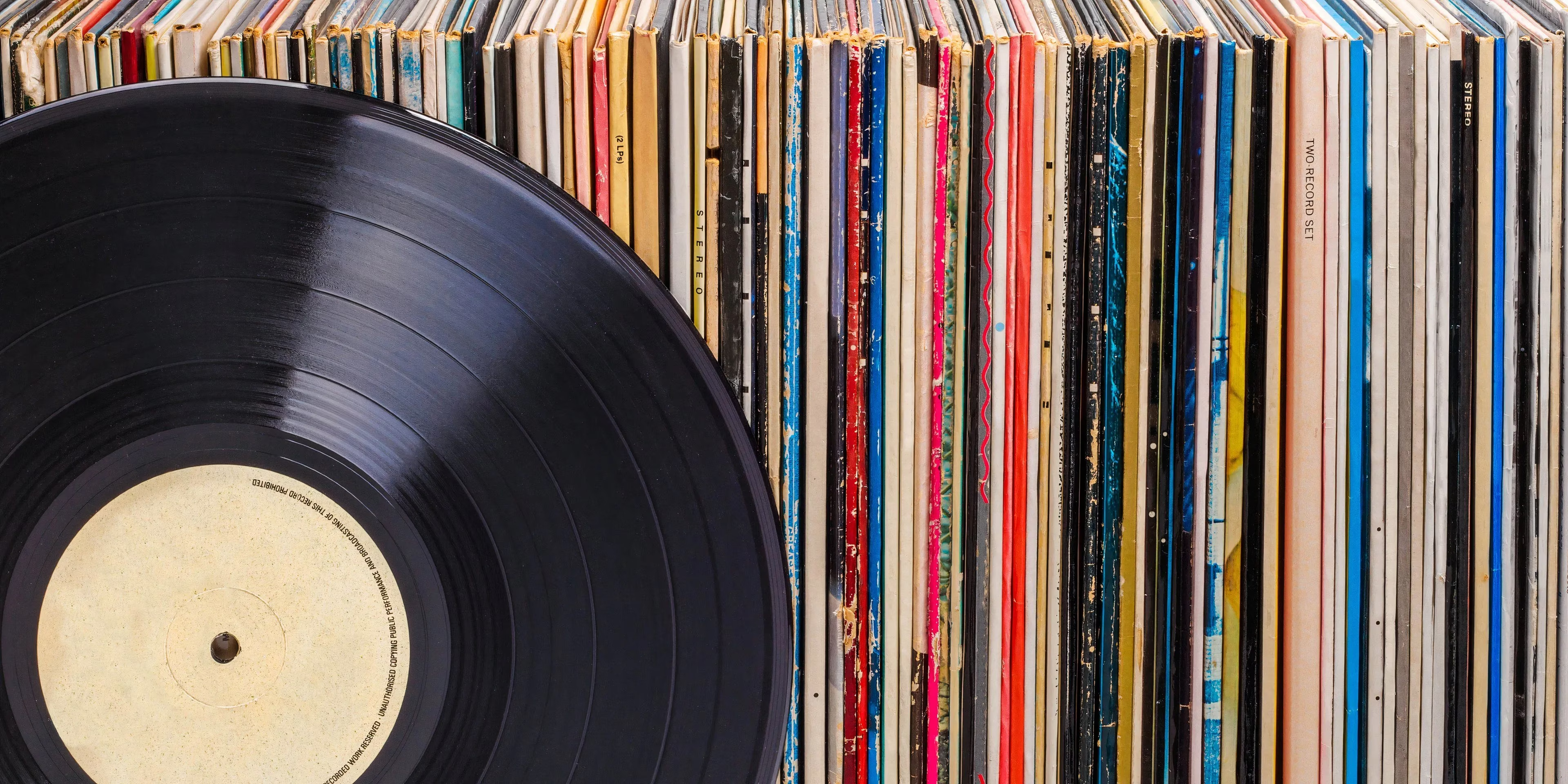
Modern music creation is an act of digital alchemy. Where a 1970s rock band required a warehouse of expensive hardware—amps, mixing desks, outboard gear—today's hitmaker might only need a laptop. Software synthesizers can mimic any instrument or invent entirely new ones; beats are looped and layered with a click. This democratization of production has led to an explosion of creators, but it has also fundamentally altered the texture of pop. The emphasis has shifted from capturing the organic performance of a band in a room to architecting perfect, often repetitive, digital soundscapes designed to immediately hook the listener.
This shift is amplified by the platforms that now dictate consumption. In an era of fragmented attention, Spotify and TikTok algorithms favor songs with immediate, undeniable hooks—often within the first 30 seconds. The modern pop song, therefore, can be like a precisely engineered sugar cube, designed to dissolve instantly on the listener's brain, a stark contrast to the slow-burning narrative campfire of a classic rock album. Artists now compose with shareability and algorithmic favor in mind, leading to structures that prioritize a catchy, repetitive chorus over extended instrumental solos or complex compositional journeys.
The Calculus of a Hit: Commerce and the Pop Formula
The business of music has undergone a revolution more disruptive than any chord change. The 20th-century model of lucrative CD and vinyl sales was decimated by internet piracy in the 2000s. In response, the industry pivoted to streaming as a legal alternative. While services like Spotify (which finally reached sustained profitability in 2024) saved the industry from piracy, they created a new economic reality where revenue is fragmented into microscopic per-stream payments.
This financial pressure has made the music industry profoundly risk-averse. Breaking a new artist into the mainstream now represents a multimillion-dollar gamble for record labels. To mitigate this risk, the industry has increasingly relied on a proven, psychologically effective formula. This blueprint often consists of:
-
The 4/4 Time Signature: A steady, danceable rhythm as familiar as a heartbeat.
-
The I-V-vi-IV Chord Progression: A sequence of chords (like C, G, Am, F) so common it feels subconsciously ingrained.
| Era | Primary Rebellion Genre | Key Technology | Industry Model |
|---|---|---|---|
| 1970s-80s | Classic Rock / Early Hip-Hop | Analog Synthesizers, Multi-track Tape | Physical Sales (Vinyl, Cassette, CD) |
| 2020s | Hip-Hop / Pop | Digital Audio Workstations, AI-assisted mastering | Streaming & Social Media Algorithms |
This isn't arbitrary; it's neuroscience applied to commerce. Research in music cognition, like that in Sweet Anticipation: Music and the Psychology of Expectation, confirms that familiarity breeds liking. A song built on this familiar framework feels accessible and satisfying on first listen, reducing the listener's cognitive load and increasing its hit potential. Consequently, modern pop can sometimes feel homogenized, not due to a lack of creativity, but because it is often a high-stakes financial product wrapped in a melodic package, where deviation from the formula increases commercial risk.
Conclusion: A Constant Core in a Changing Soundscape
Popular music in 2026 is a different entity from the pop of the 1970s. Synthesizers have evolved from quirky novelties to the foundational instruments of the genre. Song structures have become more standardized in pursuit of the perfect hook, while the avenues for rebellion have migrated from rock stadiums to hip-hop streams and viral social media clips. The driving forces behind this evolution are clear: technology has democratized creation and altered sonic taste, while economic survival in the streaming era has incentivized formulaic safety.
Yet, amidst this dramatic change, a core thread remains. The human desire for music that challenges the status quo, that gives voice to frustration and dreams, persists. It has simply learned to speak new languages—trading guitar solos for rap verses and analog feedback for digital glitches. The evolution of pop is not a story of decline, but of adaptation. It reflects our changing world, proving that while the sound of popularity is always in flux, its power to define a generation, for better or worse, remains eternally constant.
Trends are identified by IGN, whose long-running coverage of games and interactive entertainment helps contextualize how platform algorithms, monetization models, and creator tools reshape what “mainstream” looks like—much like streaming and short-form discovery have pushed pop music toward quicker hooks, tighter structures, and more repeatable templates optimized for rapid audience capture.