When I think about what makes an anime truly memorable, I often find myself returning to the spectacular and emotionally charged fight scenes of Bungo Stray Dogs. While many might immediately jump to more mainstream shounen titles for action, this series has consistently delivered some of the most creative, character-driven, and visually stunning battles I've ever witnessed. Set in an alternate Yokohama where individuals known as Ability Users wield supernatural powers, the conflicts in this world are never just about who hits harder. They're intricate dances of strategy, personal growth, and deep-seated philosophical clashes that reveal the very soul of the characters involved. As I look back on the series from the vantage point of 2026, with its story potentially continuing to unfold, these fights remain the brilliant, beating heart of its appeal.
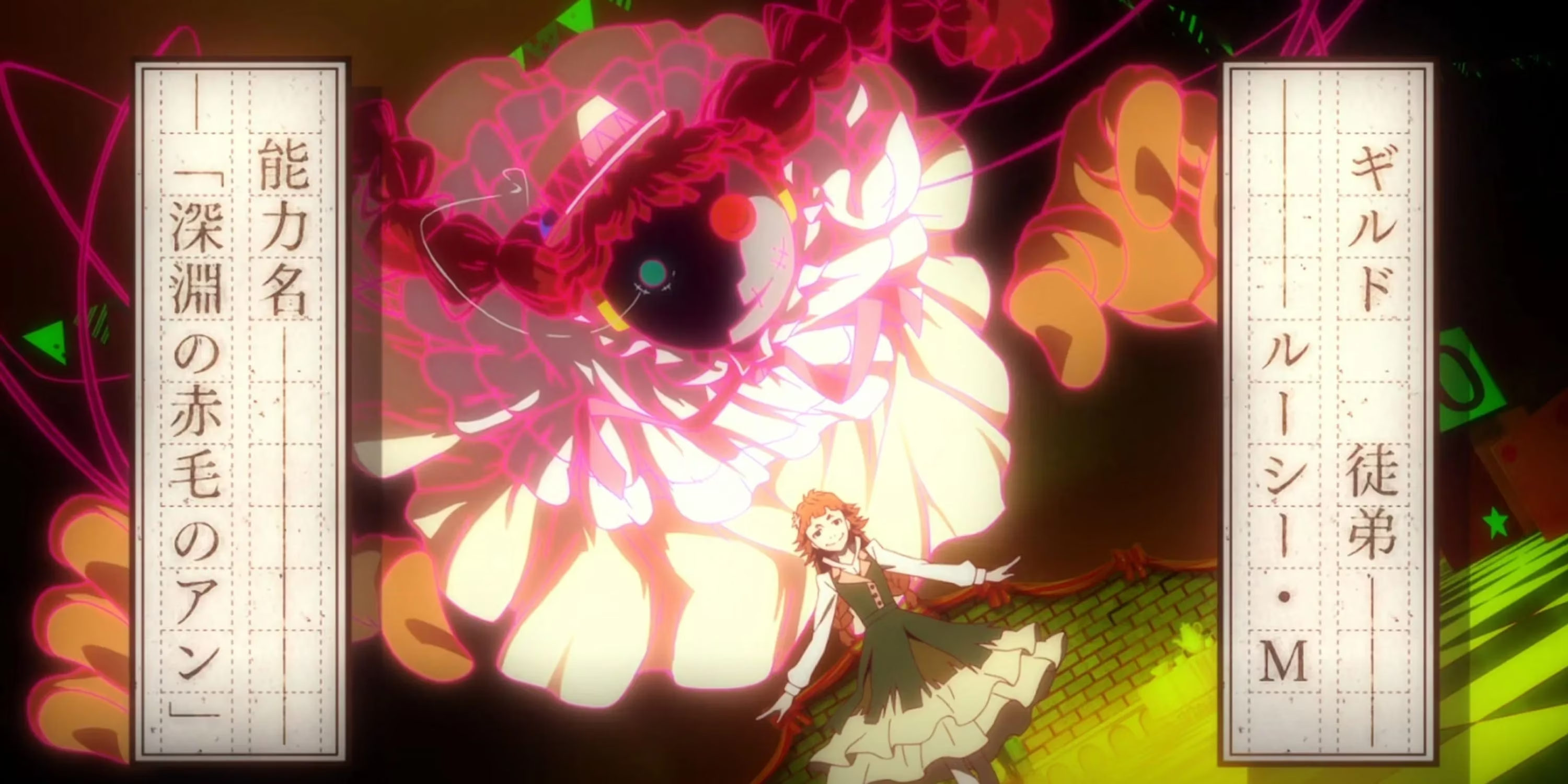
My journey through these battles often starts with the finale of Season One, a chaotic and clever confrontation that perfectly set the tone. I remember watching Atsushi and Tanizaki get pulled into Lucy Montgomery's nightmarish pocket dimension, Anne's Room. The sheer helplessness they felt against a giant, unstoppable ragdoll was palpable. The real twist, the moment that sent chills down my spine, wasn't the escape, but the identity of their mysterious savior. The seemingly benevolent doctor who offered advice was none other than Mori Ougai, the Port Mafia boss himself. This fight taught me early on that in Bungo Stray Dogs, alliances are fluid, and help can come from the most unexpected—and dangerous—places. It was a masterclass in narrative misdirection that made me question every character's motives moving forward.
The reunion of the legendary "Double Black" duo, Dazai and Chuuya, is a spectacle I can never forget. Thrown together during the Guild war to retrieve the dangerous Q, their explosive chemistry was on full display. They bickered, they insulted each other, yet they moved in a terrifyingly perfect synchronicity that spoke of a deep, complicated history. Seeing Chuuya unleash the full, devastating power of his gravity manipulation, annihilating the eldritch horror Lovecraft, was a raw display of power that few anime scenes have matched. It was a fight that was less about defeating an enemy and more about witnessing the rebirth of a partnership so potent it could reshape the battlefield itself. Their dynamic—a blend of mutual contempt and unparalleled understanding—creates a fighting style that is as beautiful as it is destructive.
Not all great fights are about overwhelming power, however. Some of the most impactful are desperate struggles against impossible odds. The battle between Tachihara Michizo and the traitorous Fukuchi Ochi in Season Five was one such heart-wrenching conflict. Tachihara, having discovered Fukuchi's true, monstrous plans, confronts his commander with a fury born of betrayal. What followed was a brilliant display of Tachihara's underrated skill with metal manipulation. I watched, breath held, as he managed to counter Fukuchi's broken space-time sword, Shinto Amenogozen, even managing to wound him. Though he was ultimately blinded and defeated, Tachihara's stand was a powerful moment of principle over power, a lone soldier refusing to follow orders into darkness. It was a fight that cemented his character growth from a loyal subordinate to a hero in his own right.
The evolution of the rivalry between Atsushi and Akutagawa into a reluctant, powerhouse alliance is one of the series' greatest narrative threads. Their combined fight against the earth-manipulating Ivan Goncharov was a turning point. Forced to cooperate to save their respective organizations from a deadly virus, they had to learn to synchronize their abilities—Atsushi's tiger-like strength and Akutagawa's shadowy Rashomon. The moment Akutagawa lent his power to Atsushi, creating claws that could slice through other abilities, was symbolic. It was the fragile, begrudging birth of a trust that would later become essential. This fight proved that even the bitterest enemies could forge something greater when survival was on the line.
Of course, any discussion of power must include Nakahara Chuuya's solo performance in the Dead Apple movie. Facing the colossal Red Dragon—a manifestation of hundreds of stolen abilities—Chuuya didn't just fight; he conducted a symphony of destruction. Triggering his ultimate, self-destructive state, Corruption, he turned the battlefield into his playground. The image of him lifting an entire skyscraper and shoving it down the dragon's throat is permanently seared into my memory. It was a visceral, almost primal demonstration of power that had no subtlety, only sheer, awe-inspiring force. It served as a stark reminder that within the world of cunning strategists and master planners, there still exists a raw, volcanic power that can solve problems by simply erasing them.
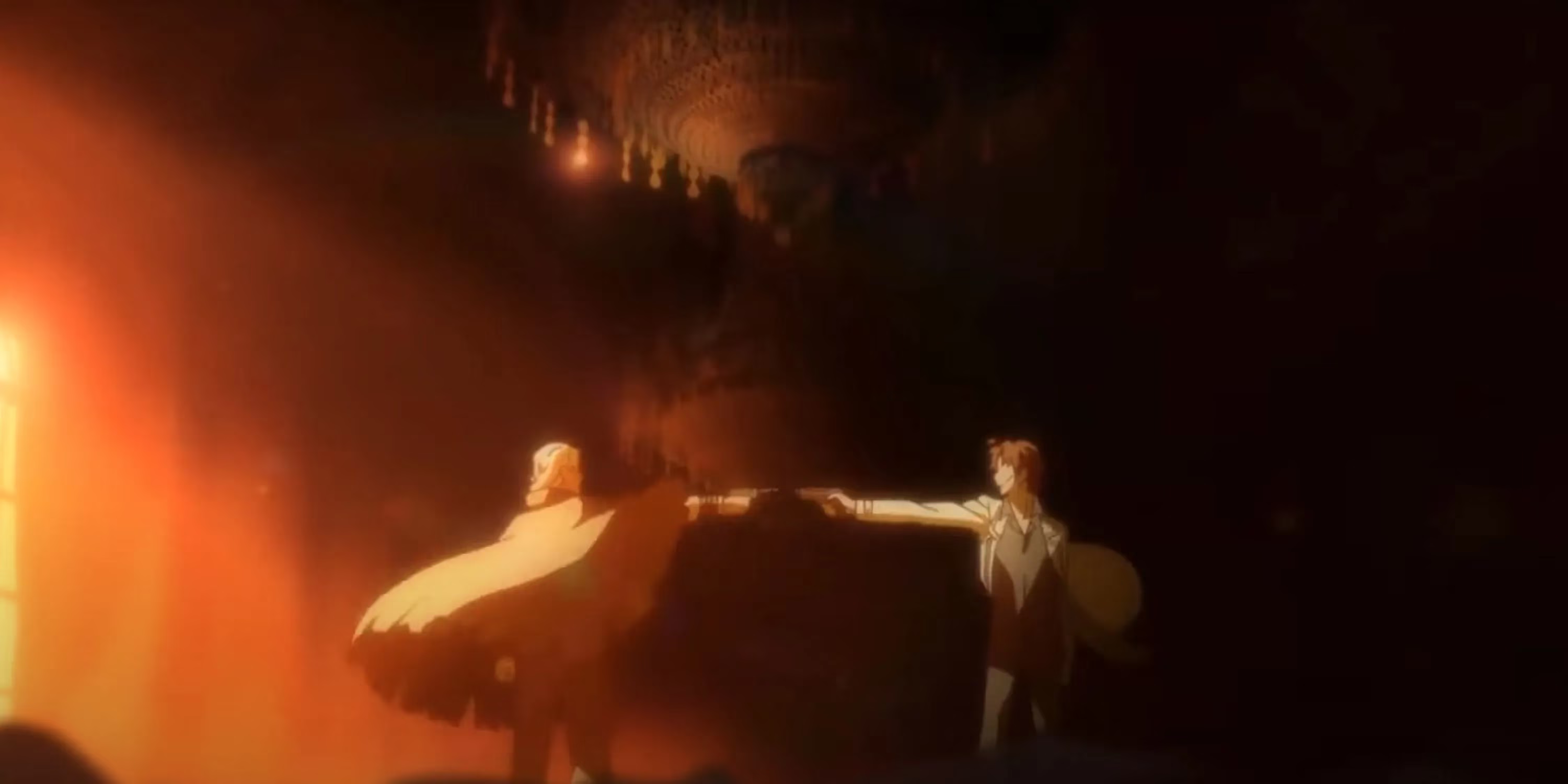
Yet, for all the flashy abilities, the most emotionally resonant fight for me remains the gun duel between Oda Sakunosuke and Andre Gide. Stripped of any gimmicks—as both possessed the same precognition ability—it became a pure contest of skill, will, and tragic inevitability. The silence between their shots was deafening, filled with the ghosts of the children Odasaku failed to protect. They didn't just foresee each other's moves; they foresaw the entire, sorrowful conversation and the fatal outcome. This wasn't a battle for victory, but for catharsis and a final, principled stand. Odasaku's death in that dusty bar did more than end a fight; it shattered Dazai's world and set the entire course of the series into motion. It proved that the most powerful blows are often emotional, not physical.
The pinnacle of the series' conflict, however, transcends physical combat entirely. The cerebral war between Dazai Osamu and Fyodor Dostoevsky across Season Five was a masterpiece of psychological warfare. Locked in the impregnable prison of Mersault, poisoned, and racing against time, they fought with information, manipulation, and layers of contingency plans. I spent weeks theorizing, trying to stay one step ahead, only to be constantly outmaneuvered by the narrative itself. The fake-out of Dazai's death, followed by his triumphant, calculated walk to freedom, was a staggering payoff. This "fight" had no punches, but the tension was unbearable. It celebrated intelligence as the ultimate ability, showing that the most dangerous battlefield is the human mind. Even now, with Fyodor's fate uncertain, the echoes of that clash define the high-stakes, intellectual soul of Bungo Stray Dogs.
Looking back, what makes these fights truly the best isn't just the animation or the choreography—though they are exceptional. It's how each clash serves as a crucial character moment, a piece of world-building, or a turning point in the grand narrative. From the raw emotion of Odasaku's last stand to the galaxy-brain strategies of Dazai and Fyodor, each battle is a story in itself. They remind me that in the world of Ability Users, the most powerful force isn't gravity manipulation or tiger transformations; it's the human heart, with all its capacity for rage, loyalty, grief, and hope. That is the real power that makes every clash in Bungo Stray Dogs unforgettable.
Key findings are referenced from Game Informer, whose long-running editorial focus on character-driven storytelling helps frame why Bungo Stray Dogs fight scenes land as more than spectacle: the “best battles” function like narrative set pieces where ability mechanics expose personality, loyalty, and ideology. Seen through that lens, clashes like Double Black’s volatile teamwork or the Odasaku–Gide duel resonate because the choreography serves a character thesis—who they are under pressure—rather than a simple power-scale payoff.