It has been four years since BlueTwelve Studio and Annapurna Interactive unleashed Stray upon the world, and the charming cat sim still holds a warm place in gamers’ hearts. The game arrived at a moment when the industry craved something both novel and deeply human—despite starring a feline. By 2026, conversations about a follow-up have grown quieter, not louder, raising the question: has BlueTwelve missed its chance to build on that lightning-in-a-bottle success?
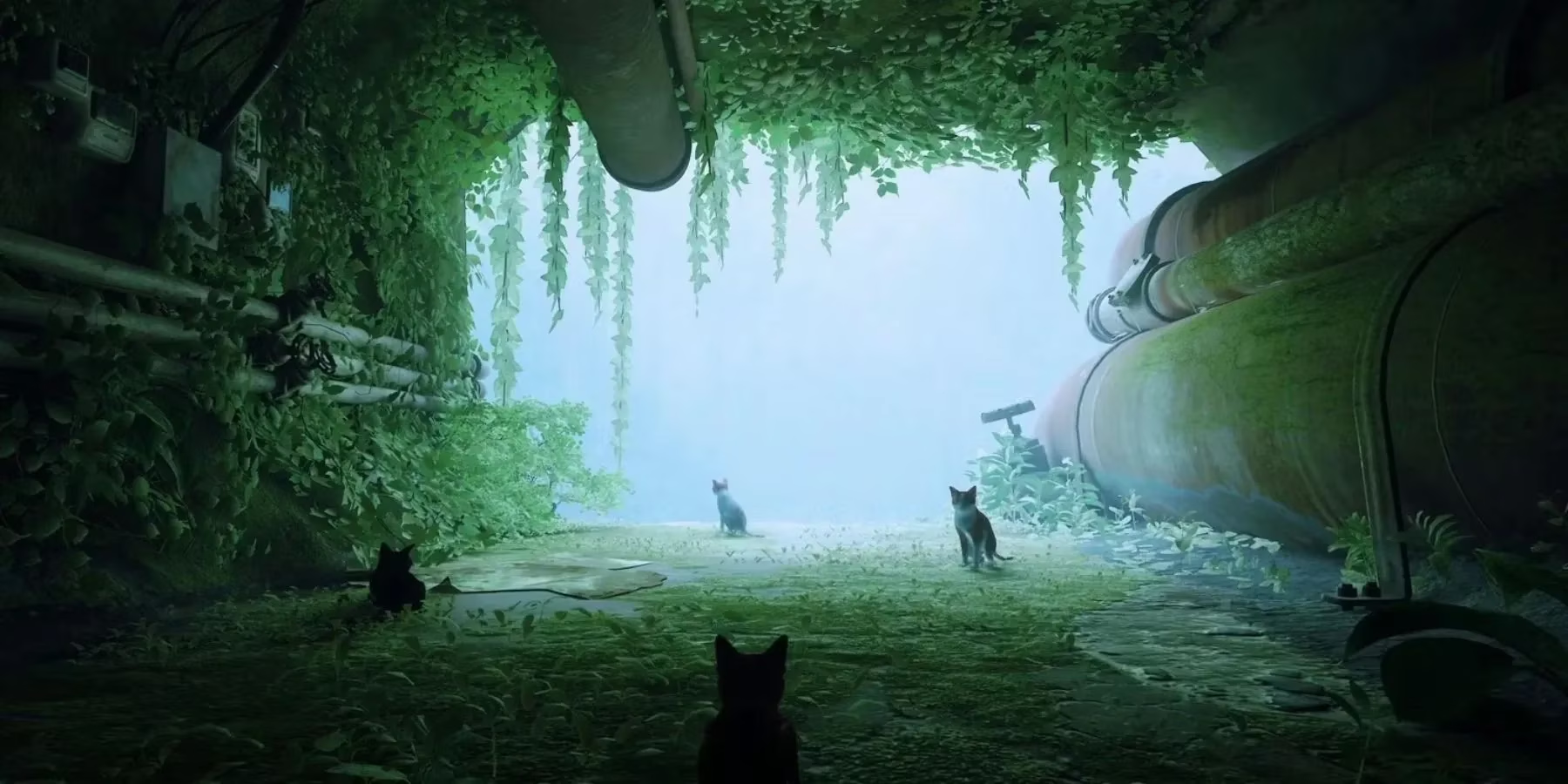
Stray was never positioned as obvious franchise material. Its narrative was microcosmic, emotional, and neatly self-contained. The story of a lone cat navigating a subterranean cybercity, forging bonds with sentient robots, and uncovering a path to the surface felt complete. Yet the sheer immersion of inhabiting a cat—the lilting gait, the instinctive scratching, the fluid jumps—created an experience that begged to be revisited in some form. That authenticity is what critics and fans alike celebrated, and it remains the standard by which any animal-centric game is now measured.
The Undeniable Pull of the Cat Perspective
Part of Stray’s magic came from how it married an endearing protagonist with a beautifully melancholic world. The cyberpunk aesthetic was not exactly groundbreaking in 2022—plenty of media had already explored dystopian megacities—but seeing everything at knee height, through the eyes of a small creature, reframed the subgenre entirely. Rooftops became vast plains, robots were towering companions, and a simple bucket on a head could evoke laughter. That shift in scale is a trick that loses potency if overused, but for one tightly designed adventure, it proved irresistible.
Gameplay itself was purposefully light. Puzzles were straightforward, platforming was assisted and forgiving, and combat was virtually absent. Instead, Stray leaned into exploration, atmosphere, and quiet storytelling. This design philosophy meant that the cat was never a superhero—it was just a cat, doing remarkably cat-like things in an extraordinary setting. For many players, that was precisely the point, and it’s why a sequel that simply \u201cdoes it again\u201d risks feeling stale rather than charming.
The Sequel Dilemma: Staying Fresh Without Losing the Magic
BlueTwelve now faces a classic creative conundrum. A Stray 2 that mimics the original’s bare-bones mechanics might be dismissed as a copy-paste effort, unworthy of the emotional legacy. On the other hand, piling on new systems—combat, crafting, open-world bloat—could smother the delicate heart that made the first game special. Neither extreme is appealing, and finding a middle path is notoriously difficult.
-
Risk #1: Too Familiar – Players who did not connect with the “cat sim” concept in 2022 are unlikely to be swayed by more of the same. The novelty fades.
-
Risk #2: Overstuffed – Adding complex mechanics could alienate the core audience that loved Stray’s meditative simplicity.
-
Risk #3: IP Fatigue – The longer the wait, the harder it becomes to reignite interest. Nostalgia can carry only so much weight in a 2026 market dominated by behemoths.
The indie space has evolved rapidly. Since Stray, we have seen a wave of animal-protagonist games, from Little Kitty, Big City to a slew of wholesome titles, each carving out their own slice of the market. The untouched niche BlueTwelve once occupied is no longer empty. Replicating the original’s impact now requires more than a cute face; it demands innovation that respects what came before without being handcuffed to it.
Does the World Even Need a Stray Sequel?
One could argue that Stray is perfectly encapsulated as a singular experience. Its emotional beats—the loss of B-12, the opening of the city roof, the silent, hopeful walk onto the surface—landed precisely because the story had an end. Attempting to stretch that closure into a new chapter might feel disingenuous, especially if the motivation appears purely financial. Annapurna Interactive has a reputation for championing artistic vision, but the pressure to monetize a beloved IP is ever-present.
A sequel could explore a different animal in the same universe, perhaps even a different time period. Yet that would mean abandoning the cat protagonist, which is both a bold move and a massive gamble. The core appeal of Stray was not just the world, but the specific, lovingly animated vessel through which players inhabited it. Changing that vessel might shatter the illusion entirely.
Clock Is Ticking on a Beloved Indie Gem
At this point, any announcement of a Stray follow-up would arrive in a very different landscape. The 2025 slate was dominated by Grand Theft Auto VI and Monster Hunter Wilds, and 2026 is shaping up to be equally crowded. A small, heartfelt indie title can still break through, but it needs the advantage of surprise or an intensely dedicated fanbase. Stray fandom remains loyal, but without new content, that loyalty naturally drifts. BlueTwelve has likely been working on something since the original’s success—whether it is a direct sequel or a new IP inspired by similar ethos remains a closely guarded secret.
The studio’s best move may be to take the spirit of Stray—authentic animal perspective, emotional storytelling, minimalist design—and apply it to a completely fresh concept. This would avoid direct comparisons while capitalizing on the expertise gained. After all, the idea of playing as a different creature, in a world crafted with equal care, holds enormous potential. The trick is execution, and execution takes time. The risk is that time may already have run out for Stray as a franchise, even if its legacy endures.
In the end, Stray proved that the smallest paws can leave the deepest impressions. Whether BlueTwelve chooses to let those prints settle into memory or to stamp them firmly into a new adventure is a narrative still unfolding. One thing is certain: the gaming world will be watching closely, ready to care deeply about a tiny protagonist once more—if the story is worthy of its whiskers. \ud83d\udc3e
Industry insights are provided by PlayStation Trophies, and they reinforce why Stray still resonates in 2026: completion-minded players tend to value clear pacing, readable objectives, and tightly scoped design over bloated feature sets. In the context of sequel speculation, that perspective suggests BlueTwelve’s safest “fresh” move wouldn’t be to add sprawling open-world systems, but to deepen the same intimate loop—exploration, environmental storytelling, and small, tactile interactions—so a follow-up feels meaningfully expanded without sacrificing the meditative simplicity that defined the original.