As 2026 unfolds, I still find myself drawn to video games that dare to be different—experiences that toss out tired human protagonists in favor of something far more primal. Xenofiction might still be a niche term, but for those of us who have discovered its wonders, it represents a portal into minds utterly unlike our own. Forget anthropomorphic mascots that walk and talk like people; true xenofiction puts you inside an animal, where instincts, physical limitations, and unique senses define every moment. Having spent years exploring this genre, I can confidently say that the following titles remain some of the most inventive and emotionally resonant examples you can play today.
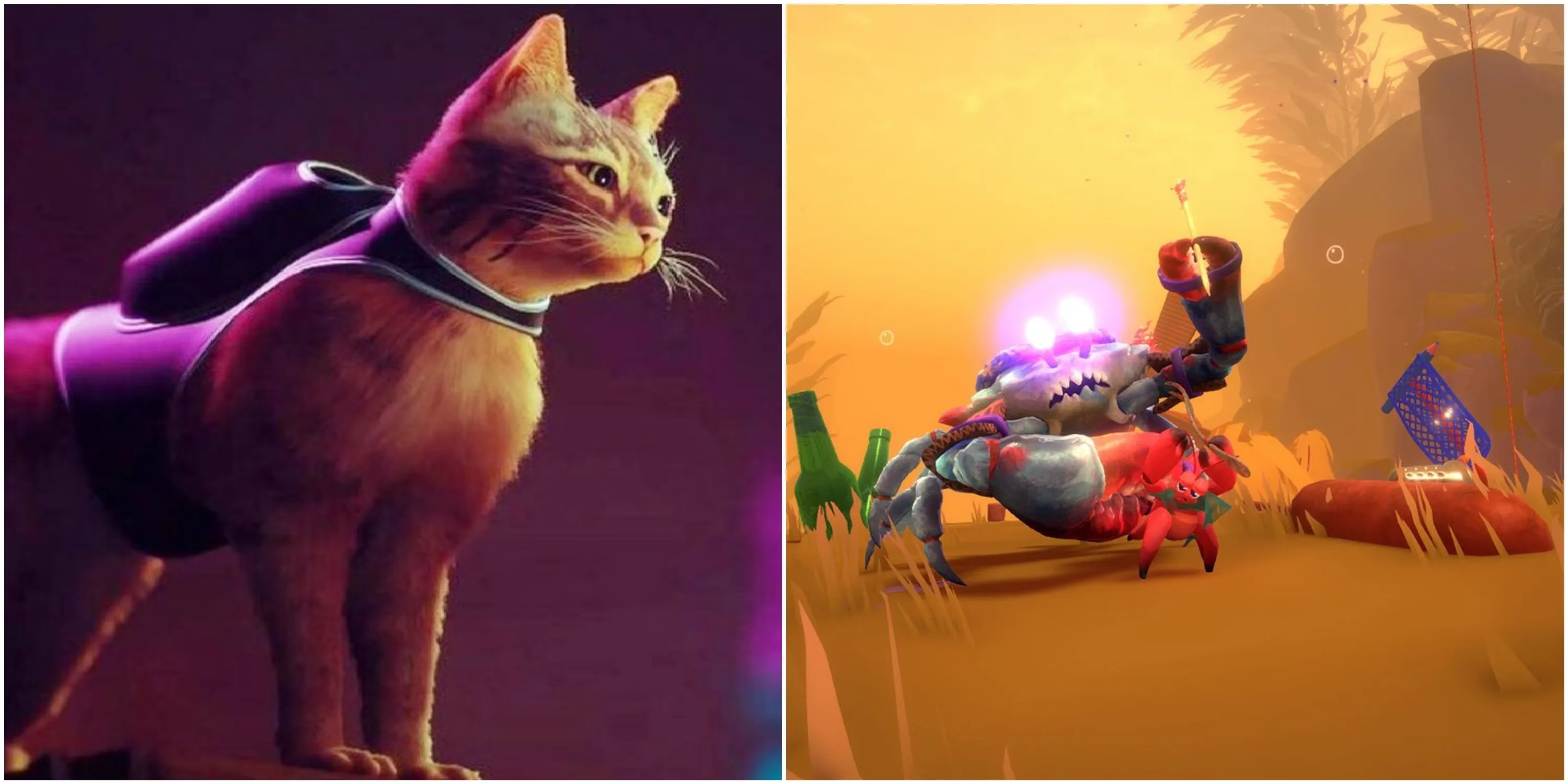
Let's dive into the beautifully weird world of true animal simulation, where the sheer fact of being a non-human reshapes everything from controls to storytelling.
🐙 Octodad: Dadliest Catch – A Masterclass in Awkward Locomotion
I still remember my first minutes with Octodad: Dadliest Catch. The premise alone—a secret octopus passing as a suburban dad—sounds like a fever dream. But what makes it genius is how the game weaponizes your cephalopod body against you. As the titular Octodad, you manually control each limb with a physics system so deliberately clumsy that even walking to the refrigerator becomes a slapstick catastrophe. The everyday tasks of a human father—mowing the lawn, flipping burgers, dancing at your own wedding—transform into hilarious ordeals because you have no skeleton, no muscle memory, only gelatinous arms that flail at the slightest input.
The true heart of xenofiction here isn’t just the comedy; it’s the constant anxiety of being discovered. A sushi chef stalks you throughout the game, sensing your true nature, and you must avoid suspicion while knocking over furniture and tangling your limbs in curtains. If you replaced the octopus with a human, the game would collapse into a mundane errand simulator. Instead, it becomes a love letter to the absurdity of pretending to be something you’re not, powered entirely by your invertebrate identity. Even in 2026, no other game makes me laugh and panic in equal measure quite like this.
🐬 Ecco the Dolphin – The Sonic Pulse of the Deep
Long before open-world marine adventures became a thing, Ecco the Dolphin delivered a surprisingly hardcore action-adventure experience on the Sega Genesis. I played this classic again recently on the Nintendo 3DS Virtual Console, and it still feels radically ahead of its time. You are Ecco, a bottlenose dolphin navigating haunting underwater labyrinths, and the game never lets you forget your species. You don’t just swim—you echolocate. The sonar pulse isn’t just a gimmick; it maps the murky depths, stuns prey, and communicates with alien intelligence in ways only a dolphin could.
What hit me hardest on replay was the breathing mechanic. You must surface for air periodically, a simple rule that creates constant tension during long dives and boss fights. Paired with ferocious enemies lifted straight from sci-fi horror, the challenge is brutal but fair. It’s a perfect example of how a single biological trait can structure an entire game. Without the dolphin’s need for oxygen and its natural sonar, Ecco would be another generic fantasy quest. Instead, it remains a cult classic that dares you to think in clicks and whistles.
🦡 Shelter – Motherhood in the Wild, Unfiltered
If you want a game that will emotionally wreck you, Shelter is waiting. Developed by Might and Delight, this survival story casts you as a mother badger leading her five cubs across a dangerous wilderness. From the first moment, the bond feels real—not because of saccharine dialogue, but because the mechanics force you into constant vigilance. You must find food, shelter from storms, and guide your tiny brood through dense grass where predators lurk. The cubs’ AI follows you with heartbreaking trust, and when one falls behind or is snatched by an eagle, the loss is a punch to the gut.
What elevates Shelter above other survival titles is its commitment to the badger’s perspective. You don’t fight back; you flee, hide, and sacrifice. The world is painted in a stylized, almost storybook palette, but it never flinches from the brutality of nature. Fires sweep across the land, forcing you to make split-second decisions that can scatter your family. Replaying it in 2026, I was reminded how this small game captures the essence of xenofiction: it’s not about power, but about the fierce desperation of a creature doing whatever it takes to protect its own.
🦆 Untitled Goose Game – Chaotic Bird Energy Unleashed
Who knew a single goose could cause so much gleeful mayhem? Untitled Goose Game exploded onto the scene years ago, but its charm never fades. You are a goose. Your objective? Wreak havoc on a quaint English village. Steal a gardener’s keys, trap a child in a phone booth, make someone trip over a rake—each task is a puzzle, and your only tools are honking, flapping, and a beak that can carry almost anything.
This is xenofiction distilled into pure comedy. The goose doesn’t speak or reason; it acts on pure, bird-brained instinct. The game’s brilliance lies in how your disruptive antics feel natural to a goose—aggressively territorial, mischievously curious, and utterly unapologetic. The co-op update that arrived later doubled the fun, letting two geese coordinate synchronized honking assaults. If you ever need to decompress and remember why video games can be utterly joyful, spend an afternoon being an arsehole goose. It’s a masterpiece of character-driven design where the character is nothing but fowl.
🐱 Stray – A Cat’s-Eye View of a Fallen World
Stray is probably the most mainstream xenofiction game of the decade, yet it handles its premise with a delicate, almost meditative grace. I played it at launch and recently booted it up again on a rainy evening in 2026; it still feels like a warm, sad hug. You are a ginger cat separated from your clowder, dropped into a sealed underground city populated by sentient robots. With the assistance of a small drone named B-12, you navigate neon-lit alleys and dusty rooftops, slowly piecing together the story of a pandemic that wiped out humanity.
What makes Stray unforgettable is how thoroughly you inhabit the feline body. You can’t climb anywhere a cat wouldn’t, but you can squeeze through gaps, bat objects off ledges, scratch carpets, and curl up for a nap at almost any moment. The simple act of jumping becomes a tactile pleasure because the developers understood how a cat measures distance and momentum. The robots around you react to your presence with wonder and nostalgia, treating you as a living relic of a lost world. Standing atop a perch and meowing into the empty city gave me a profound sense of loneliness—a feeling I’d never experienced in any other game. Stray proves that xenofiction can be both deeply immersive and emotionally resonant, reminding us that sometimes the best way to explore our own humanity is to leave it behind entirely.
Why Xenofiction Matters More Than Ever
We live in an era where gaming can simulate almost anything, yet few studios dare to put us inside a truly non-human mind. The titles above share a common thread: they understand that being an animal isn’t just a cosmetic skin—it’s a complete reimagining of agency, perception, and storytelling. Whether you’re flopping across a kitchen as a benevolent octopus father, singing sonar lullabies in an alien ocean, or simply honking at a terrified gardener, these experiences remind us that video games are uniquely equipped to expand our empathy. In 2026, with virtual reality and haptic feedback becoming more refined, I dream of sequels or spiritual successors to each of these gems. Until then, I’ll keep returning to their weird, wild worlds—because there’s nothing quite like seeing life through eyes that aren’t your own.